Last updated 16 July 2026 · Facts checked against the sources listed at the end
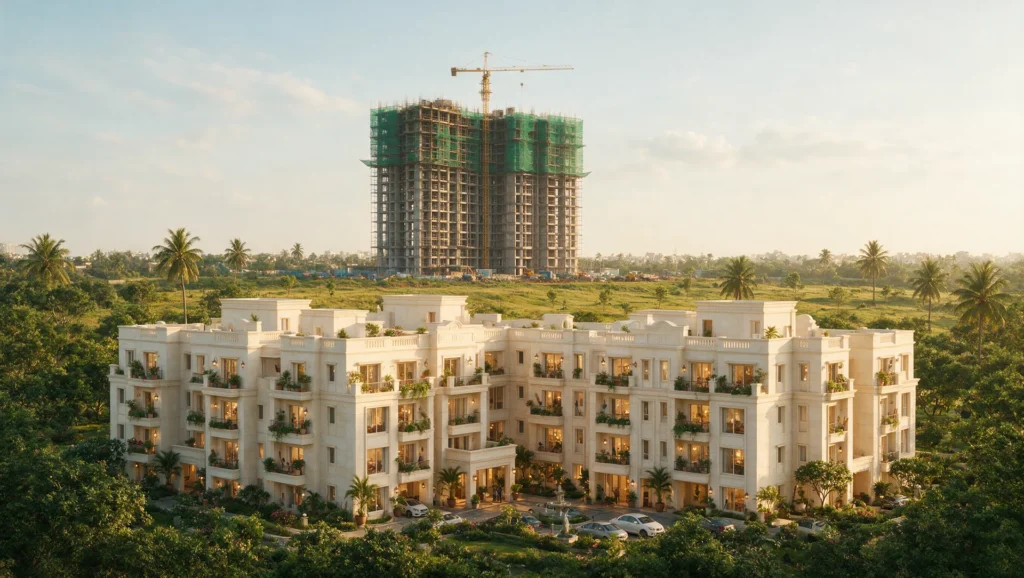
North Bengaluru’s airport corridor is an under-construction market: the branded launches hand over between 2029 and 2031, and genuinely ready stock narrows to Prestige Finsbury Park (resale only, occupancy certificate since 2023) and Brigade El Dorado’s completed phases. Ready-to-move buys zero GST, immediate tax benefit and no rent-plus-EMI years; under-construction buys a lower base, staged payments and the appreciation the ready buyer already paid for. The right answer is arithmetic, not ideology.
What is actually ready in this corridor in 2026?
Very little, and that fact shapes every choice here. The corridor’s branded pipeline is early-cycle: TVS Emerald Altura indicates 2030, Birla Trimaya’s phases run to December 2031, Godrej MSR City’s Phase 1 markets January 2029 against a March 2030 RERA outer date, and Purva Northern Lights’ three phases complete December 2029 to December 2031 (as reported; details in our price tracker). Against that, the ready shelf holds two names: Prestige Finsbury Park, completed with its 2,092-unit Hyde phase all sold and trading resale-only, and Brigade El Dorado, where six of eight phases carried occupancy certificates between 2022 and 2025 while two (Aragon and Cassia) remain under construction to a December 2028 RERA date.
Do not mistake that local scarcity for a hot market. Bengaluru as a whole is a buyer’s market on the current data: available inventory reached 72,800 units in Q1 2026, up 24% year on year, a 14-month overhang, with launches growing faster than sales (Anarock). Ready stock is thin in this belt because the belt is young, not because ready homes vanish on listing day. That distinction matters for negotiation on both sides of this choice.
What does “ready” look like, priced? The Finsbury Park test case
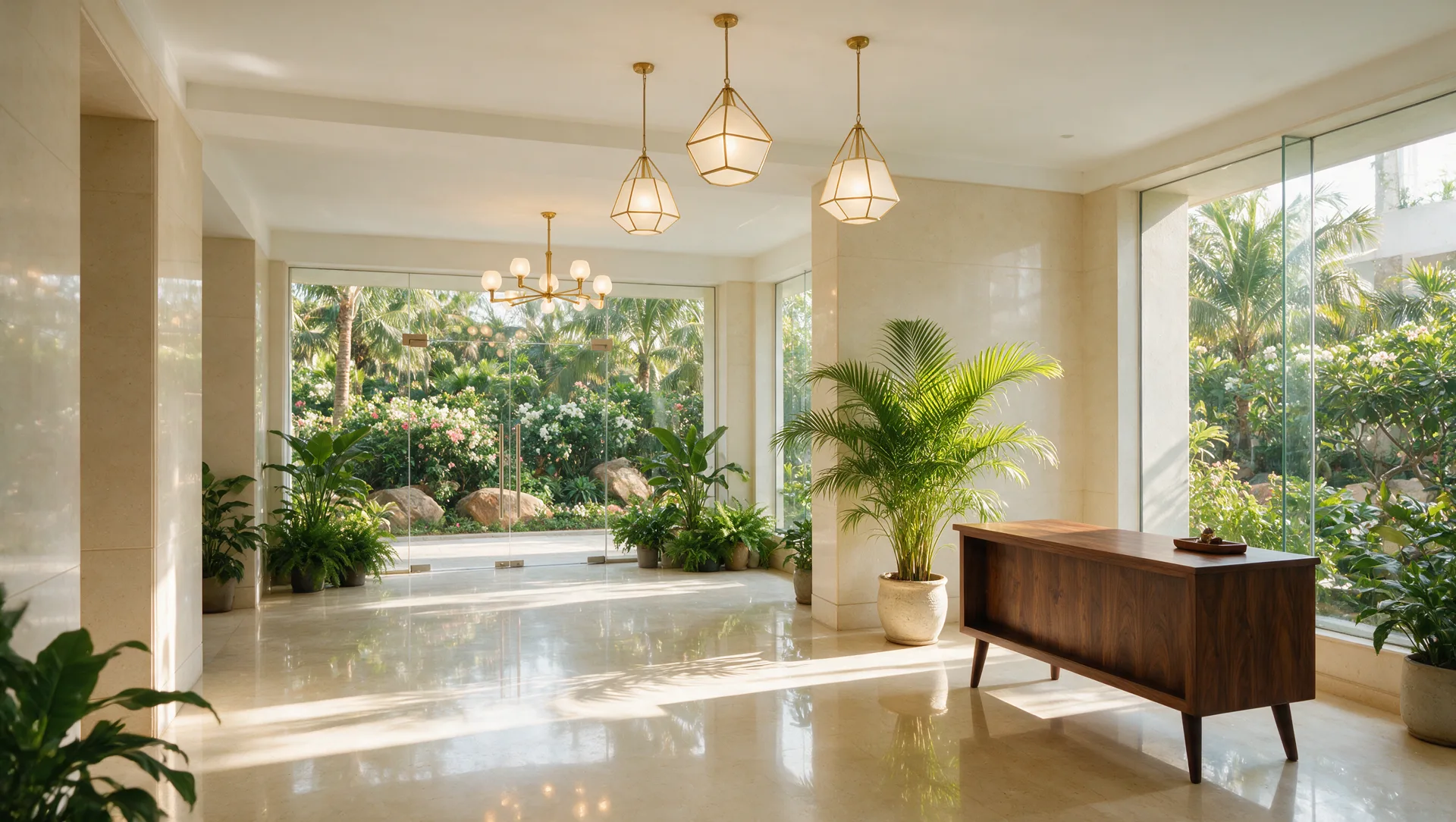
Prestige Finsbury Park is the corridor’s cleanest ready case study: roughly 25 acres and 3,050 homes across 18 towers at the KIADB aerospace-park belt (Gummanahalli–Bagalur, pin 562149), delivered in two enclaves. Hyde (12 towers, 2,092 compact 1 and 2 BHKs) received its occupancy certificate on 3 May 2023, ahead of its 30 March 2024 RERA completion date, a useful reminder that early delivery does happen; Regent (6 towers, 958 homes, 3 BHK-led) handed over through 2023, though we could not pin its separate OC date. The RERA registrations end 003055 and 003056; the promoter of record is a Prestige-group LLP per the RERA mirror we used, with the state portal itself unreachable on the day we checked.
What a buyer pays today: with developer stock exhausted, it is a resale market at roughly ₹10,500–12,500 per sq ft on super built-up (portal and broker bands, 2025–26), putting 2 BHKs around ₹1.0–1.3 Cr and 3 BHKs around ₹1.4–1.9 Cr. Launch-era sheets from 2020–21 suggest about ₹7,700 per sq ft, implying appreciation in the 40–60% range over five years; treat that as directional (broker-sourced) rather than audited. Rentals run ₹27,000–32,000 a month for a 2 BHK on live listings, with a deep rental pool. In other words: the construction-period upside here has already been banked by its first buyers. That sentence is both the case for buying ready elsewhere cheaper, and the case for buying under-construction at all.
What do GST and income tax say about the choice?
The tax system is not neutral, and it favours ready in two specific, quantifiable ways. First, GST: an under-construction home in the corridor’s price band carries 5% GST with no input-tax credit, while a completed home sold after its occupancy certificate is outside GST entirely (Schedule III treatment; the 1% concessional rate applies only to “affordable” units meeting both the carpet-area and ₹45 lakh price tests, which nothing in this band does). On the corridor’s ₹1.36 Cr entry ticket, that is roughly ₹6.8 lakh of GST the ready buyer never pays. Stamp duty, cess and registration apply identically to both routes; our Karnataka cost-of-buying guide works that separate 7–13% stack.
Second, home-loan interest. Under the old regime, a self-occupied buyer deducts up to ₹2 lakh of interest a year under the house-property head, but only from the year possession is received. Interest paid during construction is not lost; it accumulates as pre-construction interest and is claimed in five equal instalments from the completion year, inside the same ₹2 lakh cap, a treatment the new Income-tax Act, 2025 carries forward unchanged in renumbered sections from April 2026. The ready buyer starts consuming the full benefit with the first EMI; the under-construction buyer’s early interest is deferred and diluted. (Under the new tax regime, neither gets the self-occupied deduction, which quietly shrinks this particular ready advantage for new-regime filers.)
What does waiting cost, and what does staging buy?

The waiting cost is the under-construction route’s quiet line item. A family renting a corridor 2 BHK at the listed ₹27,000–32,000 a month while their home builds to a 2029–2031 possession pays roughly ₹13–19 lakh in rent across a four-to-five-year wait (our arithmetic on those listed bands), with zero equity created, on top of instalment interest. Set that against the headline discount: explainers citing industry research put under-construction base prices about 10–20% below comparable ready homes in Bengaluru, with pan-India claims stretching to 30%; those attributions reach us through secondary write-ups rather than a primary research PDF, so treat the band, not any point, as the fact. On a ₹1.4 Cr ticket, 10–20% is ₹14–28 lakh: real money, but the GST and rent lines above visibly eat into it.
What under-construction buys back is staging and choice. Construction-linked plans spread payments against progress (Purva Northern Lights, for instance, markets a 10:10:80 structure in this corridor, broker-published), so the full capital is not deployed on day one and the loan draws down gradually. Buyers also get first pick of floors and facings, current-generation layouts rather than a 2020-designed product, and the corridor’s construction-period appreciation, which Finsbury Park’s own 40–60% five-year run demonstrates is not hypothetical here. That upside is a bet, not a schedule; the same corridor also teaches that dates slip.
What protects each buyer, and what still can go wrong?
The under-construction buyer’s protections are statutory and real: 70% of collections must sit in a project-specific escrow account, withdrawable only against that project’s land and construction in proportion to progress (Section 4(2)(l)(D), RERA Act 2016); and if the promoter misses the agreement’s possession date, Section 18 lets the buyer exit with a full refund plus interest, or stay and draw monthly interest until keys (central rules peg it near SBI MCLR plus 2%). The registered outer completion date is the enforceable anchor; our RERA walkthrough shows how to read it on any certificate. None of that eliminates delay, spec drift or the years of living beside works; it compensates them.
The ready buyer’s risks move to the secondary market: title and khata chains, seller loans to be closed, transfer charges, society formation quality, and a product that is one design generation old. The occupancy certificate is the non-negotiable document (Finsbury Park’s Hyde OC is dated 3 May 2023); without it, “ready” is neither GST-free nor safely occupiable. Water diligence, as everywhere on this corridor, applies to both routes; the belt remains borewell-and-tanker dependent pending Cauvery’s rollout, and our water guide carries the checklist.
So who should pick which in 2026?
Ready fits you if you need to move within a year; you are paying serious rent today; you file under the old regime and want the full ₹2 lakh interest deduction now; delivery risk keeps you awake; or you simply want to inspect the exact flat, tower, water pressure and neighbours before paying. In this corridor that shortlist is Finsbury Park resale and El Dorado’s completed phases, priced at today’s rates with the appreciation banked.
Under-construction fits you if your horizon is three to five years; you can carry rent plus instalments, or you live rent-free; staging matters to your cash flow; you want current-generation product and first pick of inventory; and you are buying the corridor’s growth thesis deliberately, protected by escrow and Section 18 but exposed to time. That is the lane our tracked projects occupy, compared line by line in the under-₹2-crore shortlist.
Run your own two numbers before deciding: your true monthly rent times your honest months-to-possession, and 5% of your shortlisted ticket. If their sum approaches the under-construction discount on offer, ready is not the expensive option it looks. If Altura’s lane is yours, request the current cost sheet and put the same arithmetic against it.
- Prestige Finsbury Park, Hyde and Regent pages (Prestige Group), as of 2026.
- Finsbury Park Hyde RERA record, OC 3 May 2023 (AurumPropTech RERA mirror), as of 16 Jul 2026; the state portal was unreachable when we checked.
- Finsbury Park rental listings (99acres), as of Jul 2026 (via search snippets).
- Finsbury Park resale bands (BookNewProperty, broker), as of 2025–26.
- GST on under-construction vs ready property (NoBroker Legal), as of 2026.
- Ready vs under-construction premium, Bengaluru (Trade Brains), 2026.
- RERA 70% escrow rules, s.4(2)(l)(D) (LegalEye), 2025.
- Section 18 remedies for delayed possession (Bajaj Finserv), as of 2026.
- Pre-construction interest, the one-fifth rule (ClearTax), as of 2026.
- House-property provisions under the Income-tax Act, 2025 (CAclubindia), 2026.
- Bengaluru Residential Market Viewpoints, Q1 2026 (PDF) (Anarock), published Apr 2026.
- Brigade El Dorado phase OC status (NxtFootstep, broker review), 2026.