Last updated 16 July 2026 · Facts checked against the sources listed at the end
Yelahanka is the present: roughly ₹10,450/sq ft (up ~20% in a year per 99acres, July 2026), piped Cauvery water via Stage V, schools and hospitals in place. Devanahalli is the future: ₹9,800–12,550/sq ft, beside the airport’s job engine, but piped Cauvery arrives only with Stage VI. Match the choice to your horizon.
What actually separates Yelahanka and Devanahalli?

Yelahanka is an established suburb inside BBMP limits: two decades of apartment build-out, colleges, organised retail and now piped Cauvery water. Devanahalli is the airport taluk further north, where the corridor’s factories, campuses and townships are still going up. Their headline prices now overlap, which is precisely why buyers compare them: a similar rate buys either a finished suburb or a frontier with a larger growth story attached.
The overlap is recent. 99acres rate data from July 2026 puts Yelahanka flats at an average of about ₹10,450/sq ft after a 20.1% rise in one year (one of North Bengaluru’s sharpest moves), while Devanahalli lists across a wide ₹9,800–12,550/sq ft band, reflecting a market where branded townships price well above older stock. The direction of supply is not in doubt: Anarock’s Q1 2026 Bengaluru report has North Bengaluru taking 34% of the city’s new launches (up 37% quarter-on-quarter), second only to the East.
How do prices, rents and fundamentals compare in 2026?
On asking rates the two are closer than their reputations suggest: ~₹10,450/sq ft average in Yelahanka against ₹9,800–12,550/sq ft in Devanahalli (both 99acres, July 2026). Rents diverge far more than prices (portal and blog estimates put a Yelahanka 2 BHK at ₹22,500–28,000 a month versus ₹18,000–22,000 in Devanahalli) because tenants pay for infrastructure that exists today, not infrastructure that is targeted.
| Measure | Yelahanka | Devanahalli |
|---|---|---|
| Flat rates, Jul 2026 | Avg ~₹10,450/sq ft , range ₹8,250–14,050 (99acres) | ₹9,800–12,550/sq ft (99acres) |
| 1-year price change | +20.1% flats; +21.1% apartments (99acres) | Not separately printed in our sources; neighbouring Bagalur +13.5% as a corridor proxy |
| 5-year corridor signal | No 5-year print in our sources | Bagalur, the belt beside it: +120.5% over 5 years (99acres) |
| 2 BHK rent (portal/blog estimates) | ₹22,500–28,000/month | ₹18,000–22,000/month |
| 3 BHK rent (portal/blog estimates) | ₹38,000–48,000/month | ₹25,000–32,000/month |
| Gross rental yield (estimates) | No locality-specific print; North Bengaluru band ~3–4.5% (secondary sources) | 3.2–3.8% (property-blog estimate, 2026) |
| Piped Cauvery water | Yes: Stage V (commissioned 16 Oct 2024) covers the Yelahanka zone | No: borewells + tankers today; Stage VI approved Feb 2026, unbuilt |
| Metro (targeted) | Yelahanka station, Hebbal–Airport leg targeted Jun 2027 | Doddajala and Airport City stations on the same leg |
| Nearest job anchors | Manyata and Kirloskar Business Park on the city side; Hebbal offices | Foxconn (~30,000 hired by Dec 2025), SAP Labs (3,200 staff), KIADB Aerospace Park |
| Supply character | Established and dense; little fresh land | Frontier; North Bengaluru = 34% of Bengaluru’s Q1 2026 launches (Anarock) |
| Social infrastructure today | Colleges, malls and hospitals in place | Thinner today; airport-city hotels and venues due 2026–28 |
Sources: 99acres property-rate pages (July 2026), Anarock Bengaluru Q1 2026, BWSSB/press reporting, portal and blog rent estimates as attributed. These are asking rates, not registered values; verify current pricing with the seller or developer.
Who wins on water, and by how much?
Yelahanka, decisively, for now. It sits inside BBMP limits, and its zone is on the coverage list of Cauvery Stage V, the ₹4,336 crore, 775 MLD scheme commissioned on 16 October 2024 for the 110 villages added to BBMP. Devanahalli has no piped Cauvery at all today: the town runs on borewells, tankers and a 640 KL/day potable-reuse scheme (reported by Salar News, 2025), and its pipe arrives only with Stage VI, which was approved by the state cabinet in February 2026 (₹6,939 crore, 500 MLD) but is not yet built.
Two honest caveats keep this from being a clean sweep. First, Stage V’s rollout is incomplete: over 1.75 lakh connections had been made by early 2026 against a 4-lakh target, and OpenCity’s October 2025 tanker survey found inside-BBMP pockets such as Jakkur and Vidyaranyapura still without connections. Second, the groundwater beneath both localities is categorised over-exploited by CGWB: extraction in the northern taluks runs at more than twice recharge, city borewells have gone as deep as ~1,500 ft, and Yelahanka’s borewell water is notably hard.
For Devanahalli buyers the practical question is tanker economics until Stage VI is commissioned (a process of years, with World Bank/JICA funding still being sought). BWSSB’s Sanchari Cauvery tankers charge ₹740 per 6,000 L and ₹1,290 per 12,000 L; private loads were capped at ₹1,000–1,200 per 12,000 L in the March 2024 crisis order, against pre-cap market rates of ₹1,800–2,500 and crisis peaks near ₹3,000. The fuller checklist (STPs, rainwater harvesting, borewell NOCs) is in our North Bengaluru water guide.
Does the metro favour one side?
No: the same Blue Line serves both, and the airport stretch is currently targeted to open first. BMRCL’s phasing, as reported in June 2026: Silk Board–KR Puram targeted December 2026, Hebbal–Airport targeted June 2027, ahead of the middle KR Puram–Hebbal leg (December 2027). Yelahanka gets a namesake station; the Devanahalli side is served by Doddajala, Airport City and the KIAL Terminals stations. Every date is a target, and this project has a history of slippage.
Progress is real, though: civil works on the 58.19 km line stood at ~71% by end-April 2026, BEML delivered the first six-coach driverless trainset on 7 June 2026 (per Metro Rail News), and trial runs on the ORR stretch are slated from October 2026. On the roads, the new Hebbal flyover loop (airport-to-Mekhri direction) opened on 1 January 2026. It is today’s biggest single commute gain, and it accrues mainly to Yelahanka and Jakkur residents heading into the city. The suburban rail airport corridor (KSR–Yelahanka–Devanahalli, 41.4 km) is tendered and targeted around 2028, but its timeline is fluid. Net: connectivity is roughly a wash on paper. What differs is what each station connects you to.
Where are the jobs on each side?
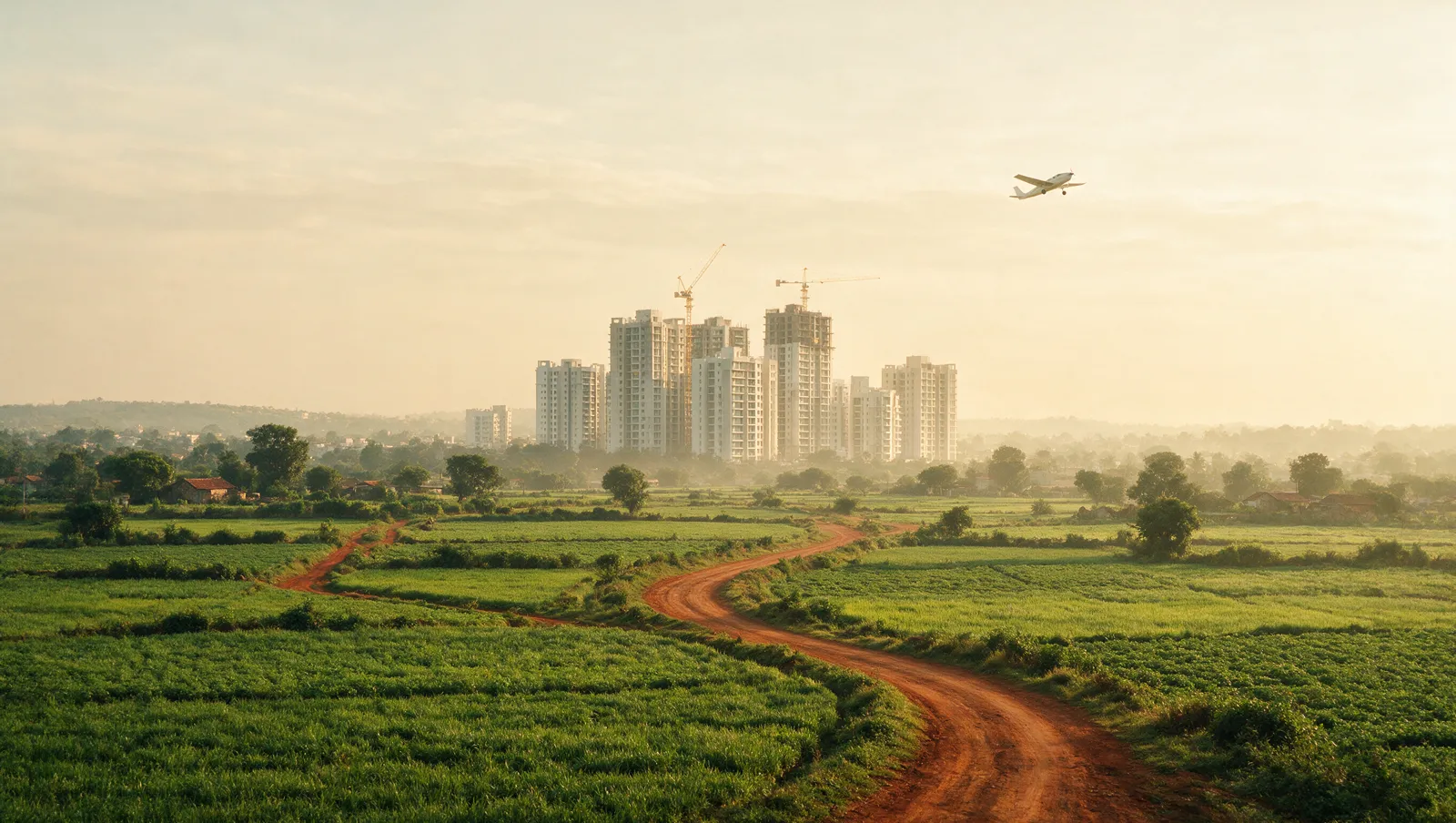
Yelahanka borrows its employment from the city side: Manyata and Kirloskar Business Park at Nagawara–Hebbal are its commute anchors, and that market is deepening: Embassy REIT signed Commonwealth Bank of Australia for about 1.4 million sq ft at Embassy Manyata, with delivery from Q4 CY2026. Devanahalli hosts the new economy itself: Foxconn’s iPhone plant (~30,000 hired within its first nine months, per December 2025 reporting), SAP Labs’ 41-acre campus (opened 2025 with ~3,200 staff, built for 15,000) and the ~3,000-acre KIADB Aerospace Park with Boeing, Airbus and Collins Aerospace.
Scale the Devanahalli story correctly: Foxconn’s ~₹20,000 crore investment and 50,000-job figure are a reported plan and a target respectively. The verified number is 30,000. The airport itself keeps compounding: 44.47 million passengers in FY2025-26 (+6.2%, with international traffic up 23.9%), a 2-million-sq-ft business park under way in Airport City, a 775-key twin hotel expected by end-2026 and a concert arena around 2027-28. One correction worth making: KWIN City, the ₹40,000 crore knowledge city, is at Doddaballapura–Dabaspet (roughly 45 minutes from the airport), not in Devanahalli, whatever brochures imply. And Hebbal’s ~₹14,450/sq ft (up 12.4% in a year) shows what living next to the city-side job base already costs; Yelahanka is the affordable end of that gravity, Devanahalli a bet the gravity moves north.
Which is more liveable today?
Yelahanka, comfortably. It has an established grid: Presidency University, the Galleria mall on its doorstep, Phoenix Mall of Asia a short drive down the Hebbal side (open since October 2023), and hospitals and schools that predate the corridor story. Devanahalli’s daily-life infrastructure is thinner; its marquee additions (hotels, an arena, a convention destination announced with Prestige in June 2026) serve the airport economy first and residents second.
The belt between them holds several of the schools families actually shortlist: Stonehill International at Tarahunise, Akash International at Devanahalli, CMR University on the Hennur–Bagalur road. Builder blogs also list hospital expansions on both sides (a Manipal expansion signal in Yelahanka, a large teaching-hospital plan in Devanahalli), which we could not verify to our standard; treat those as unconfirmed until the operators publish dates. This liveability gap is precisely what the rent gap prices: tenants pay for what exists, which is why Devanahalli’s rents trail even where its headline ₹/sq ft overlaps Yelahanka’s.
What sits between them, and why it matters
The Sathanur–Bagalur belt along Bagalur Main Road is where the two markets meet. Bagalur listed at about ₹9,700/sq ft in July 2026 after +13.5% in a year. Its +120.5% over five years is the strongest sourced five-year move in the corridor. The belt sits beside the Aerospace Park, closer to city-side offices than Devanahalli and closer to the airport economy than Yelahanka, which is why so much of the new 2 & 3 BHK supply has landed there.
We cover this ground in detail in the Sathanur location guide and the airport-corridor explainer. Projects such as TVS Emerald Altura in Sathanur (2 & 3 BHK from ₹1.36 crore, developer site, July 2026) typify the belt’s positioning, and our under-₹2-crore shortlist compares it with eight rivals. One caution travels with the belt: outside BBMP limits it shares Devanahalli’s water reality (borewells and tankers until Stage VI), so the same due-diligence checklist applies.
So which should you pick?
Pick Yelahanka if the suburb must work from day one: piped Cauvery in most of the zone, established schools, a shorter run to city-side offices, and resale depth. Pick Devanahalli if your horizon is long and you want exposure to the corridor’s job engine at a lower entry point, accepting tanker-fed years until Stage VI and execution risk on every targeted date.
The risks cut both ways, and honestly. Yelahanka: a 20.1% one-year run is already in the price, density and traffic are rising, borewell water is hard where Cauvery hasn’t yet connected, and some BBMP pockets are still waiting on Stage V connections. Devanahalli: no piped Cauvery today, metro and factory targets can slip (June 2027 is a target, not a promise; 50,000 Foxconn jobs is an ambition, not a headcount), and supply is heavy. Bengaluru’s inventory overhang was 14 months in Q1 2026, with 58% of new launches priced ₹1.5–2.5 crore, so your eventual resale will have company.
This is general information, not personalised investment advice. Match the decision to your own horizon and finances. If the belt between the two fits your brief, you can book a site visit or request the current cost sheet from the advisory.
- Property rates & price trends in Yelahanka (99acres) (sibling rate pages cover Devanahalli, Bagalur and Hebbal), as of Jul 2026.
- Bengaluru Residential Market Viewpoints Q1 2026 (Anarock), as of Apr 2026.
- Rental price trends in Bangalore (Nestriqo (property blog)), as of 2026.
- Property prices in Devanahalli 2026 (NxtFootstep (property blog)), as of 2026.
- CM inaugurates Cauvery Stage V (ProjectX India), as of 15 Nov 2024.
- Cabinet okays ₹6,939 crore Cauvery Stage VI (Deccan Herald), as of Feb 2026.
- Bengaluru water tankers survey 2025 (OpenCity), as of 27 Oct 2025.
- Blue Line trial runs from October 2026; Hebbal–Airport June 2027 (Swarajya), as of 21 Jun 2026.
- Foxconn Devanahalli hiring ~30,000 (Business Standard), as of 22 Dec 2025.
- SAP Labs opens €194 mn Devanahalli campus (BW Businessworld), as of 2025.
- BLR airport FY2025-26: 44.47M passengers (Deccan Herald), as of Apr 2026.
- Embassy REIT leases 1.4M sq ft to CBA at Manyata (Embassy REIT), as of 2026.